
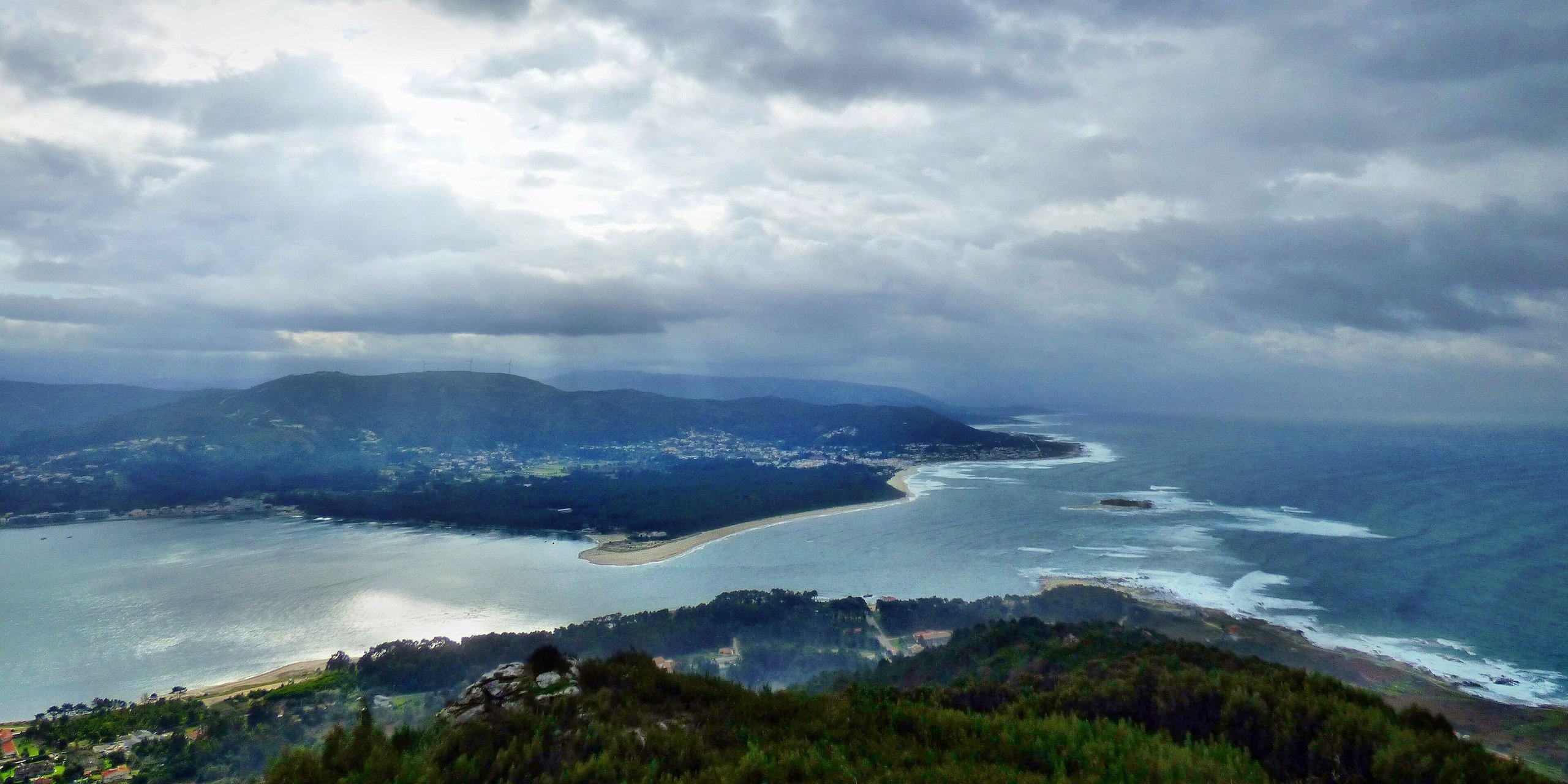

This line focuses on developing advanced tools to analyse and predict extreme phenomena in estuaries, highly complex systems where river and marine processes interact. It addresses extreme events such as floods, storms, high river flows and episodes of rising temperatures, which can have negative consequences at several levels.
The methodological approach combines the downscaling of global climate models to obtain high-resolution regional information with the modelling of the hydrological cycle using physically based models and neural network techniques to transform rainfall into runoff. It also integrates the modelling of estuaries with two-dimensional (2D) numerical models, such as Iber, and three-dimensional (3D) models, such as Delft3D, which is a key element of this line.
2D models are computationally fast and make it possible to explore many scenarios efficiently, while high-definition 3D models play a central role by representing the full dynamics of the ria in detail, including vertical processes, stratification and complex circulation. Combining and integrating both approaches balances efficiency and accuracy, providing a robust tool for analysing, managing and anticipating extreme events in coastal-fluvial systems.
Researchers
- Marisela Des Villanueva (coordinator). EPhysLab. Xunta de Galicia grant to complete postdoctoral training, until 2027.
- Diego Fernández Nóvoa (coordinator). EPhysLab. Xunta de Galicia grant to complete postdoctoral training, until 2027.
- Xurxo Costoya Noguerol. EPhysLab. Ramón y Cajal fellowship, until 2029.
Techniques and services we offer
- Downscaling techniques (WRF modelling) to improve the resolution of global climate models. Several climate variables available at high resolution, and the possibility of processing new variables of interest.
- Neural network applications for hydrological and climate processes.
- Two-dimensional (Iber) and three-dimensional (Delft3D) hydrodynamic modelling.
- Advice on hydrodynamic modelling and neural network applications.
Selected publications
- Castro-Olivares, A., Des, M., Decastro, M., Thomas, B., & Gómez-Gesteira, M. (2025). Assessing the vulnerability of commercial bivalves to intensifying atmospheric heatwaves in coastal ecosystems. Marine Environmental Research, 209, 107210. https://doi.org/10.1016/j.marenvres.2025.107210
- Des, M., Castro-Olivares, A., Decastro, M., & Gómez-Gesteira, M. (2025). Analysis of estuarine marine heatwaves in an upwelling system: The Ría de Arousa as a case study. Global and Planetary Change, 249, 104776. https://doi.org/10.1016/j.gloplacha.2025.104776
- Fernández-Nóvoa, D., Soares, P. M., García-Feal, O., Costoya, X., Trigo, R. M., & Gómez-Gesteira, M. (2025). Neural network approach for modeling future natural river flows: Assessing climate change impacts on the Tagus River. Journal of Hydrology: Regional Studies, 58, 102191. https://doi.org/10.1016/j.ejrh.2025.102191
- Thomas, B., Costoya, X., Decastro, M., Insua-Costa, D., Senande-Rivera, M., & Gómez-Gesteira, M. (2023). Downscaling CMIP6 climate projections to classify the future offshore wind energy resource in the Spanish territorial waters. Journal of Cleaner Production, 433, 139860. https://doi.org/10.1016/j.jclepro.2023.139860