
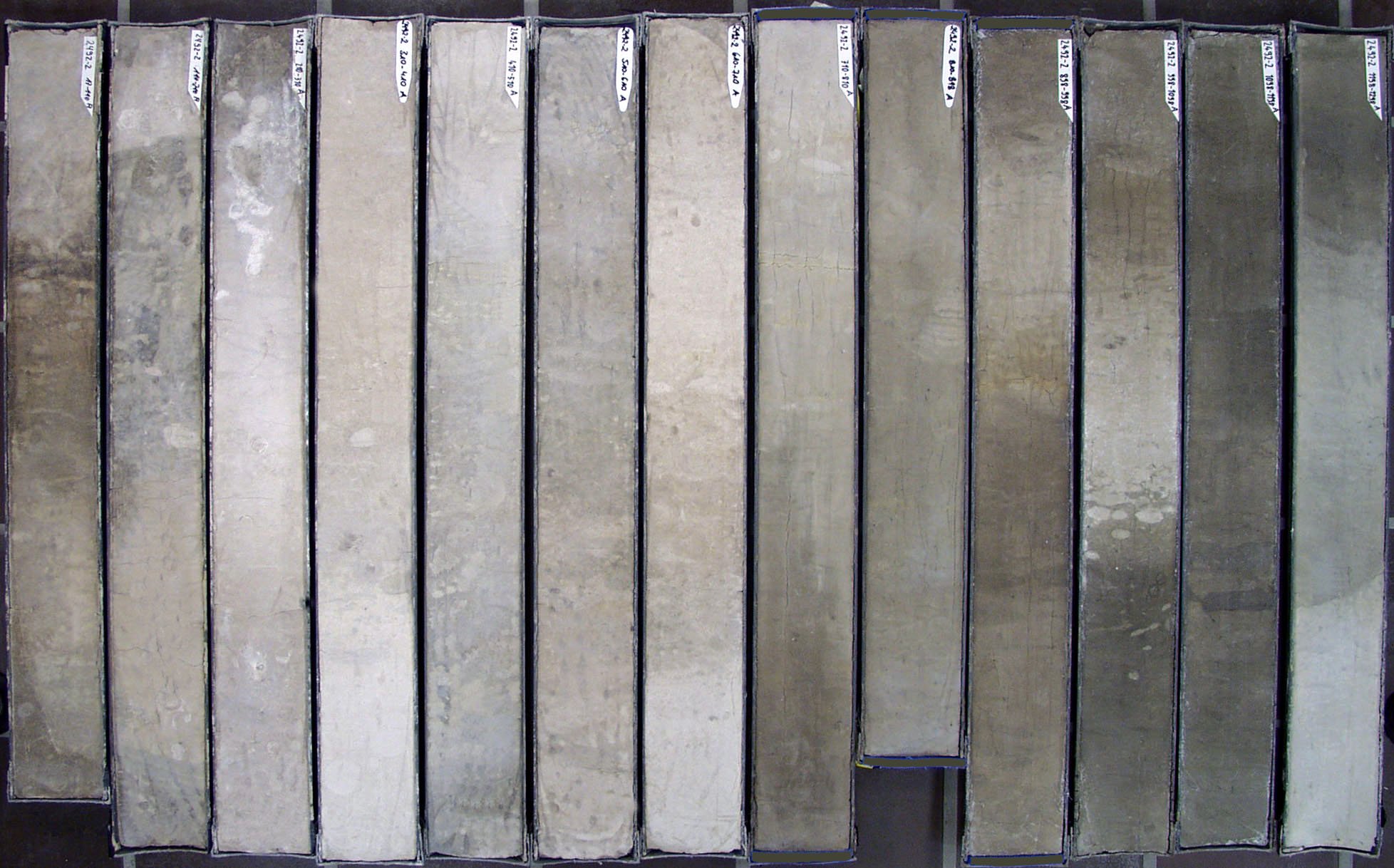

We develop new tools to study climate change and other environmental changes in marine ecosystems, both modern and past, from the sedimentary record. Micropalaeontology and mineralogy are the core techniques of this line.
We use well-established microfossil bioindicators, such as dinoflagellate cysts (resting stages of microscopic algae), but we also explore other organic microfossils with potential for (palaeo)ecology, such as ciliate cysts, copepod eggs and other resting structures formed by marine organisms and preserved in sediments.
The detailed study of mineral assemblages in sedimentary sequences helps us understand the geochemical reactivity processes operating in modern sediments and infer the geochemical conditions that prevailed in past marine environments. It is also a very useful tool for reconstructing the climatic evolution of other planetary bodies, such as Mars.
Microscopic analysis of microfossils, combined with the physicochemical characterisation of clays and other minerals, makes it possible to assess organic matter preservation in coastal systems and its potential as a (palaeo)environmental and ecological status indicator.
Researchers
- Iria García Moreiras (coordinator). Marine and Environmental Geology, GEOMA (XM-2). Xunta de Galicia grant to complete postdoctoral training, until 2028.
- Carolina Gil Lozano. Geological Oceanography and Biogeochemistry (XM-1). Talent retention contract, until 2029.
Techniques and services we offer
- Processing and preparation of sediment samples for palynology and micropalaeontology (core description, subsampling, chemical treatment, sieving to concentrate microfossils and mounting of permanent microscope slides).
- Identification (taxonomy) and quantification of organic microfossils (dinoflagellate cysts and other non-pollen palynomorphs, NPP) in sediment samples, with environmental interpretation.
- Palynofacies analysis and characterisation of organic matter: origin (marine or terrestrial) and state of preservation.
- Statistical analyses applied to biodiversity studies, age models and biostratigraphy.
- Mineralogical characterisation of sediments and clays by XRD, FTIR, Raman, XPS and SEM-EDX.
- Preparation of laboratory analogues, both synthetic and natural, of different sedimentary and geochemical environments.
- Experimental simulation in chambers and geochemical modelling (PHREEQC) of mineral alteration processes.
- Advice on sampling design in marine and coastal sediments for applied stratigraphic studies.
More information
- Marine Palynology Lab (Iria García Moreiras): iriagamo.webs9.uvigo.es
- Marine and Environmental Geology Group (GEOMA): geoma.net
Selected publications
- García-Moreiras, I., Pospelova, V., García-Gil, S., & Muñoz Sobrino, C. (2018). Climatic and anthropogenic impacts on the Ría de Vigo (NW Iberia) over the last two centuries: A high-resolution dinoflagellate cyst sedimentary record. Palaeogeography, Palaeoclimatology, Palaeoecology, 504, 201–218. https://doi.org/10.1016/j.palaeo.2018.05.032
- García-Moreiras, I., Amorim, A., & Zonneveld, K. (2024). Transport and preservation of calcareous and organic-walled dinoflagellate cysts off Cape Blanc (NW Africa) in relation to nepheloid layers. Marine Environmental Research, 199, 106577. https://doi.org/10.1016/j.marenvres.2024.106577
- Gil-Lozano, C., Muñoz-Iglesias, V., López-Ramírez, M. R., & Gago-Duport, L. (2026). Optimizing Raman spectroscopy for detecting organics in nontronite-rich Martian analogues. Applied Clay Science, 292, 108336. https://doi.org/10.1016/j.clay.2026.108336
- Gil-Lozano, C., Baron, F., Gaudin, A., Lorand, J. P., Fernandez, V., Hamon, J., & Mangold, N. (2024). The key role of bedrock composition in the formation of carbonates on Mars. Geochemical Perspectives Letters, 28, 54–59. https://doi.org/10.7185/geochemlet.2403